Stone, lime and light: Mediterranean architecture materials
The materials that make a Mediterranean villa work: local stone, lime render, terracotta and shade. How each behaves in summer heat, and what each costs to keep.

What makes a building Mediterranean?
The question sounds obvious but the answer is rarely straightforward. Mediterranean architecture is not a single aesthetic. It encompasses the whitewashed volumes of the Balearic islands, the ochre stone of Provence, the pale limestone townhouses of the Côte d'Azur, the tiled courtyards of Andalusia. What these traditions share is not an image but a logic: buildings designed to manage heat, filter light, and blur the boundary between interior and exterior.
Contemporary Mediterranean architecture draws from this logic rather than imitating its surface. The materials described below are the physical carriers of that logic. They are also the materials that give projects in this region their particular quality: weight, warmth, and an insistence on belonging to the place they are in.
Stone
The primary material
Stone is the defining material of Mediterranean architecture because it was, historically, the material that was there. Every region has its own: calcaire de Provence (the pale golden limestone quarried in the Var and Bouches-du-Rhône), caliza in Andalusia and the Balearic islands, pietra di Lecce in the Italian south, the volcanic basalt of certain Spanish islands.
The contemporary use of stone is not nostalgic. Stone works in a Mediterranean climate for technical reasons:
- Thermal mass: dense stone absorbs heat during the day and releases it at night, reducing the need for mechanical cooling in summer.
- Hygroscopic behaviour: natural stone breathes, managing surface moisture in a way that synthetic cladding cannot.
- Durability: properly specified and installed, limestone and sandstone structures require minimal maintenance over decades.
Formats and applications: stone is used structurally (load-bearing walls, vaulted ceilings), as cladding (interior and exterior), as paving, and as decorative detail in openings and stairs. Each application has different requirements for thickness, finish (honed, brushed, split face), and fixing method.
Indicative cost ranges: for high-quality Provençal limestone as exterior cladding, budget €180 to €350 per m² for supply and installation, depending on slab size and finish. Spanish caliza at comparable quality runs slightly lower. For paving, €120 to €250 per m² installed is a realistic range for premium natural stone in these markets.
The name behind the studio
Cantera is the Spanish word for stone quarry. It is the root of the studio's name and its founding material reference. The studio's design approach is grounded in this: every project begins with a material conversation about what belongs to the ground it sits on.
Lime
The surface that breathes
Traditional Mediterranean renders are lime-based. Enduit à la chaux in France, mortero de cal in Spain: the same principle across the region. Lime render has been largely displaced by cement-based products in mass construction, but its properties remain superior for both heritage and contemporary projects in a warm, humid coastal climate.
Why lime over cement render?
- Lime is vapour-permeable: it allows walls to breathe, preventing moisture from being trapped inside the substrate. In a coastal context where walls are subject to sea air and humidity cycles, this is a significant advantage.
- Lime has natural self-healing properties: hairline cracks close as the material continues to carbonate over time.
- Lime finishes age well. A cement render in direct sun bleaches and cracks; lime deepens and acquires a patina that reads as deliberate rather than degraded.
Finishes: the range runs from rough trowelled (enduit gratté) to polished lime finishes (marmorino, tadelakt). One clarification worth making, because the two are routinely confused: béton ciré is cement based, not lime based. It can look close to a polished lime finish and behaves nothing like it, with none of the vapour permeability described above. On an old stone wall that distinction decides whether the wall dries or traps water. For contemporary Mediterranean exteriors, a medium-coarse lime render left with a slight texture reads correctly against stone, timber, and raw concrete.
Indicative cost: €45 to €90 per m² for exterior lime render, applied in two or three coats, depending on the complexity of the surface and the finish specification. Venetian plaster for interiors: €80 to €180 per m² depending on the number of layers and degree of polish.
Timber
For structure, shade, and detail
Timber in Mediterranean architecture is primarily outdoor timber: pergola structures, shutters (volets en bois), brise-soleil, and exterior joinery. It is also a structural material in traditional roofs (exposed beam ceilings are a defining interior feature from Provence to Andalusia).
Exterior timber in a coastal Mediterranean climate requires careful specification. Species and treatment matter:
- Thermally modified timber (heat-treated to improve stability and resistance): increasingly used for exterior cladding and decking where maintenance needs to be low.
- Iroko and teak: proven performers in exterior applications in the region, with natural oils that resist humidity and UV degradation. Higher cost (€100 to €200 per m² for decking installed), justified by longevity.
- Local hardwoods where available: Chêne vert and Chêne pubescent (varieties of oak) in Provence, adapted to the local climate.
For interior exposed beams, reclaimed timber is often the most interesting option — both aesthetically and structurally. A beam from a 17th-century Provençal farmhouse has already completed its drying and movement cycle; it will not shrink or crack in service the way new timber might.
Concrete
Used honestly
Concrete belongs in contemporary Mediterranean architecture when it is used honestly — as a structural material that acknowledges what it is, not as a substitute for stone or render. Béton brut (board-formed concrete or polished concrete) in interior floors and walls can anchor a space visually, providing contrast against the warmth of stone and timber.
The risk with concrete in this context is thermal: a highly glazed villa with polished concrete floors and no thermal mass in the walls can overheat severely in July. Concrete works when it is part of a considered thermal strategy, not when it is applied as an aesthetic preference independent of the climate.
Polished concrete floors: €60 to €120 per m² installed for a standard polished finish. Coloured or exposed-aggregate concrete adds cost and complexity.
Metal
Brass, iron, and steel as accents
Metal in Mediterranean architecture appears in window frames, balustrades, door hardware, and light fittings. The traditional materials are wrought iron and bronze; contemporary equivalents are steel (raw, blackened, or powder-coated) and brass.
Brass ages well in Mediterranean light — it develops an uneven patina that reads as quality rather than degradation. Raw steel requires either an interior application or a conscious acceptance that it will rust and be treated accordingly. Aluminium is functional but cold; in a high-specification project it is typically reserved for structural or hidden elements.
For windows and large glazed openings, steel-framed systems (such as those used in industrial heritage buildings) have become a defining detail in contemporary Mediterranean interiors. They allow very thin profiles and maximum glass area while carrying architectural weight that aluminium equivalents do not.
Light and the indoor-outdoor principle
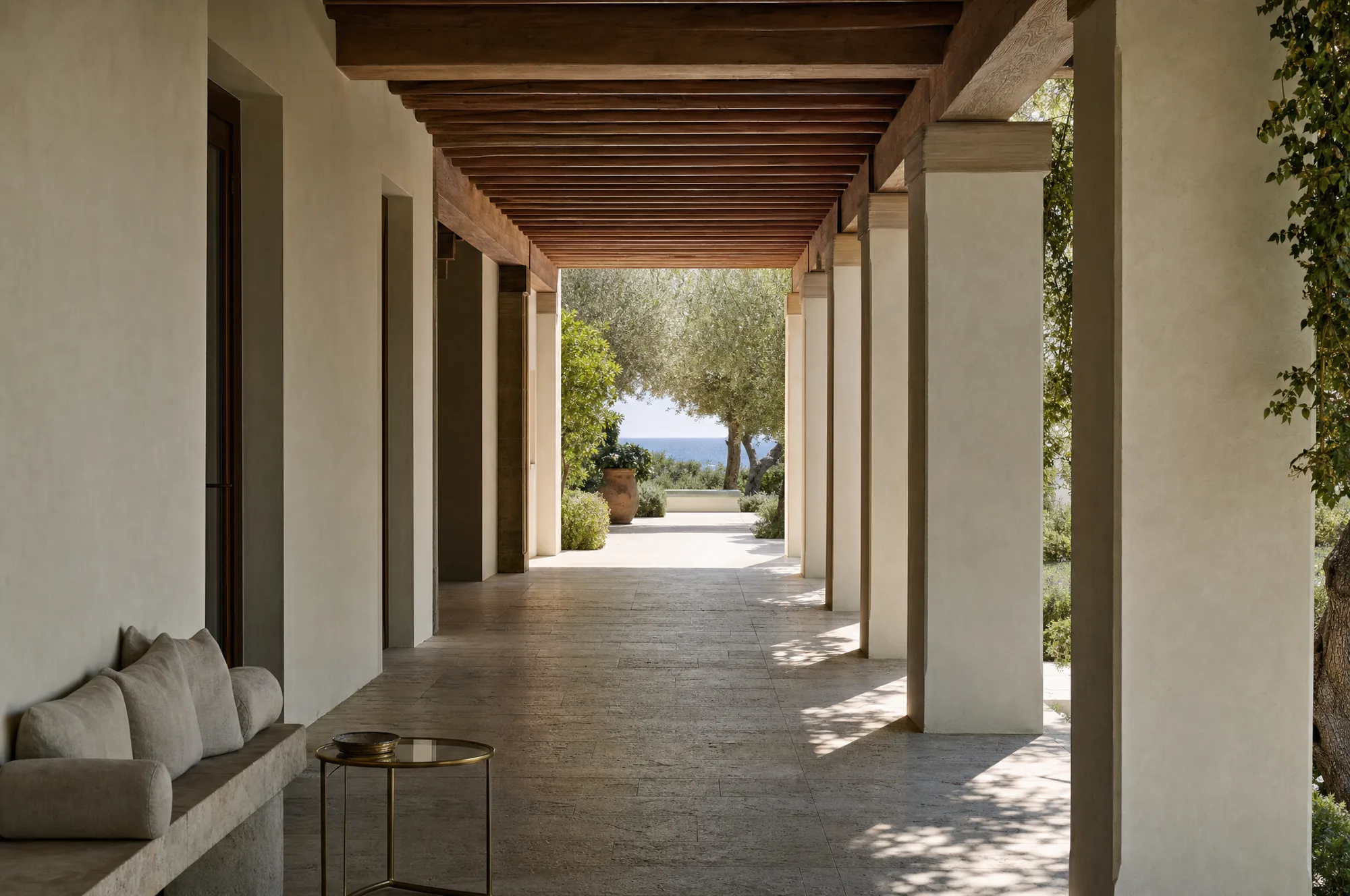
The spatial logic behind the materials
Material choice in Mediterranean architecture is inseparable from the relationship between inside and outside. The goal is not to bring the outside in (a phrase that describes a failure to design the transition properly) but to make the transition itself an architectural event.
This requires decisions at the design stage, not the decoration stage:
Orientation: in the Northern Mediterranean (Côte d'Azur, Provence, Costa del Sol), the ideal orientation for the primary living spaces is south to south-west, with deep overhangs or pergola structures that block the high summer sun while allowing low winter sun to penetrate.
Overhang depth: a simple rule — the overhang depth should equal roughly the height of the glazing it shades, calibrated to the latitude. At 43° N (Nice, Marbella), a 1.2 m overhang above a 2.4 m window will shade the glass from May to September while admitting full sun from October to April. This is passive solar control without mechanical systems.
Thresholds: the most important detail in a Mediterranean house is the threshold between interior and exterior. A raised step, a change in floor material, a drop in ceiling height — these signal the transition without closing it. A seamless large-format tile from the living room to the terrace looks resolved in photographs but eliminates the spatial rhythm that makes a house feel inhabited rather than staged.
Glazing performance: large openings require high-performance glazing (low-e coating, triple glazing in cooler months, solar control glass for south-facing elevations). The performance gap between a well-specified glazing system and a poorly specified one can mean a 30% difference in cooling load. In projects where summer comfort matters, this is not a detail to value-engineer.
What the paperwork does to the palette
Materials are not only a design decision on the Mediterranean: on the French side, any change to a façade visible from a listed monument goes through an outside opinion, and the the French planning code add a month to the instruction period when it does. In Andalucía, the municipal building licence governs the same ground, and the the Junta de Andalucía guide to building licences sets out the procedure.
We do not specify a stone we have not seen laid. Colour shifts between two quarries in the same region, and a catalogue sample says nothing about how a wall will weather. Where no reference building can be visited, we ask for a trial panel before committing a façade.
Frequently asked questions
What is the defining characteristic of contemporary Mediterranean architecture? It is an architecture that responds to its climate and landscape through material and spatial choices — thermal mass, natural ventilation, deep shade, and the management of the indoor-outdoor threshold — rather than one that imposes an image regardless of context.
Is natural stone practical for a modern villa, or is it expensive to maintain? Properly specified and sealed, natural stone (limestone, sandstone, travertine) is among the lowest-maintenance exterior materials in a Mediterranean climate. It does not fade, does not require repainting, and improves in appearance with age. The higher upfront cost is offset by reduced long-term maintenance compared to painted or rendered surfaces.
Can contemporary architecture use traditional Mediterranean materials without looking pastiche? Yes — the key is using materials for their physical properties rather than their associations. Stone used because of its thermal mass and local origin reads differently from stone used as a decorative skin over a concrete frame. The architecture feels grounded when the material logic is consistent; it feels imitative when materials are applied as a style choice without structural or climatic justification.
What is the typical budget for high-quality natural stone in a villa renovation? For exterior limestone cladding on the French Riviera or in Andalusia, budget €180 to €350 per m² supplied and installed, depending on stone origin, slab dimensions, and finish. Interior floor paving in natural stone ranges from €120 to €250 per m² installed.
How does the indoor-outdoor relationship affect the architectural brief? It should be the first design parameter established, not a finishing decision. Orientation, overhang depth, threshold details, and glazing performance need to be resolved at the concept stage. Adding an outdoor living area as an afterthought produces a house with a terrace. Designing from the outdoor-indoor relationship outward produces a Mediterranean house.
For how these materials and principles translate into a managed villa project on the Côte d'Azur or the Costa del Sol, read Turnkey villa renovation on the French Riviera and Costa del Sol. For guidance on choosing the right architect for the region, see Finding an English-speaking architect in South of France and Spain.
Before you commit to a material palette. Send us two photographs of the existing walls and one of the site in afternoon light. We will tell you what the substrate most likely is, what it can take, and which of the finishes above are realistic on it. Write to us.
Sources checked on 1 September 2026: the French planning code, Junta de Andalucía.
Studio note. write to us.

Turnkey villa renovation: French Riviera and Costa del Sol
How a turnkey renovation is run from abroad: decision gates, site reports, local trades and the calendar of a Mediterranean villa project, season by season.

The elements of contemporary Mediterranean villa design
Courtyards, wall thickness, cross ventilation and indoor-outdoor living: the design elements that define a contemporary Mediterranean villa, and why they endure.