Turnkey villa renovation: French Riviera and Costa del Sol
How a turnkey renovation is run from abroad: decision gates, site reports, local trades and the calendar of a Mediterranean villa project, season by season.

Can you really renovate a Mediterranean villa without being there?
Yes — provided you have an architect who acts as your permanent representative on the ground. At Atelier Cantera, remote project management for international clients on the French Riviera, in Provence, and on the Costa del Sol (Marbella, Sotogrande) is not an add-on service. It is the core of what we do.
This article explains our model in plain terms: what we take care of without involving you, where you remain the decision-maker, and what realistic timelines and fees look like for a full villa renovation in these markets.
What a turnkey renovation actually means
The term "turnkey" is used loosely in the construction industry. For Atelier Cantera, it means a single point of responsibility from the first site visit to the handover of keys — including:
- Architectural design and interior design developed together from the outset, not as two separate commissions.
- Permit handling: permis de construire in France, licencia de obras in Spain, and liaison with the relevant heritage authorities when applicable (ABF on the Riviera, PGOU in Andalusia).
- Contractor selection and coordination: we maintain a network of trusted builders, craftsmen, and specialists in each region. We do not send your project to whoever answers first.
- Site supervision: regular site visits, photographic and video reporting, and weekly written updates in English.
- Procurement and specification: materials, fixtures, and furniture selected and ordered by the studio, delivered to site. You approve samples and choices remotely; we manage the supply chain.
- Final snagging and handover: we walk the finished property on your behalf, document every outstanding item, and clear it before you travel.
"The client bought a farmhouse in Provence, flew in twice — once for the design brief and once for the handover. Everything in between was managed remotely." — Gabriel Chaussée, HMONP, Atelier Cantera
How you stay in control without being on site
Remote ownership does not mean losing visibility. Our communication protocol is designed for clients in different time zones:
Weekly site reports are sent every Friday and include dated photographs of progress, a list of decisions made during the week, and any items requiring your input. They are written in English, with French or Spanish summaries available on request.
Decision gates are scheduled at key moments: design validation, material approval, structural choices, and budget reviews. Outside these gates, the project moves forward without requiring your attention.
Video walkthroughs are provided at each major phase completion — demolition, shell work, finishes — so you can see the space before the next phase is committed.
A single contact: Gabriel Chaussée coordinates architects, engineers, contractors, and craftsmen. You communicate with one person, in English, regardless of the number of parties on site.
What we will not do remotely. Commit to works on a property we have not visited, sign off completion from photographs, or file for permission before verifying which regime applies. Everything else, design, arbitration, weekly reporting, runs perfectly well from a distance.
What a typical villa renovation timeline looks like
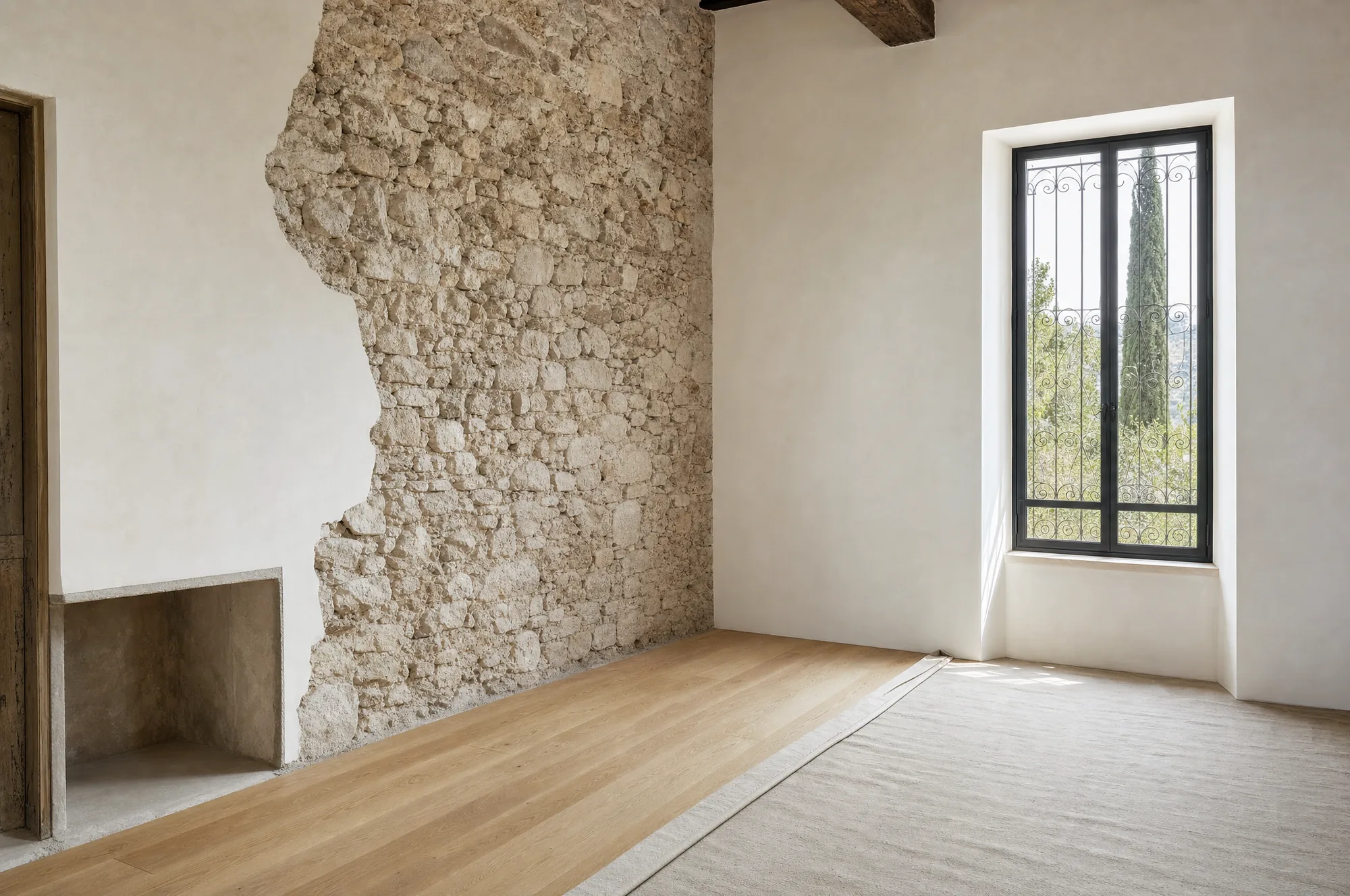
Timelines vary with scope, permit complexity, and the condition of the existing structure. Below are realistic ranges for full renovations in our core markets.
French Riviera (Alpes-Maritimes, Var) and Provence:
- Permit application to approval: 3 to 5 months (longer near classified sites or in ABF perimeters).
- Full renovation of a 250 to 500 m² villa: 10 to 18 months on site after permit.
- Design and procurement phase before permits: 2 to 3 months.
- Total project duration, concept to handover: 15 to 26 months.
Costa del Sol (Málaga province, Marbella, Sotogrande):
- Permit timelines vary significantly by municipality. Budget 4 to 8 months for a full licencia de obras mayor.
- Full renovation of a comparable villa: 8 to 16 months on site.
- Total project duration: 14 to 26 months.
Partial renovations (interiors only, no structural changes, no permits required) can be completed in 6 to 12 months.
The permit is the part of the calendar nobody can compress. On the French side the the French planning code set two months for a single house and three for other permits, plus a month where an outside opinion is required; lighter works may need only a déclaration préalable. On the Costa del Sol the municipal licence runs on its own timetable, set out in the the Junta de Andalucía guide to building licences.
What does it cost?
Fees and construction costs are two separate lines.
Architect's fees for a full turnkey mission (design through site supervision) typically range from 12% to 18% of the construction budget, depending on the project's complexity and level of interior specification. For remote-management-intensive projects, this reflects the additional coordination and reporting work. That range describes the market rather than our own rate: Atelier Cantera charges between 10 and 15 % for a full mission, broken down phase by phase on the Services page.
Construction costs on the French Riviera and in Marbella for a high-end renovation: indicative range of €2,500 to €4,500 per m² of renovated floor area, depending on finishing level and structural scope. Luxury finishes (natural stone, bespoke joinery, high-performance glazing) push the upper end of this range.
A 300 m² villa renovation at mid-to-high finish level: total project cost in the range of €900,000 to €1,500,000 including fees, depending on site condition and specification.
These figures are indicative. Every project receives a detailed cost plan at the end of the design phase, before any commitment to build.
Why the Mediterranean requires a specific kind of practice
Not every architect fluent in English understands the French administrative system or the specifics of Spanish planning law. The two systems are structurally different, involve different consultants, and have very different timeframes and risk profiles.
Atelier Cantera was founded by Gabriel Chaussée, an architect trained at the École Spéciale d'Architecture in Paris, registered with the French Ordre des Architectes and holder of the HMONP qualification. The studio operates in French, Spanish, and English and has active experience on both sides of the border.
The studio's identity is built on Mediterranean materiality — stone, lime render, timber, the relationship between indoor and outdoor space — which means the architecture does not read as imported. It belongs to the landscape it sits in.
Frequently asked questions
Can Atelier Cantera manage a renovation on the French Riviera or in Spain if I am based in the UK, Scandinavia, or the US? Yes. All client communication is conducted in English. Site management, contractor coordination, and permit handling are managed locally. You can be based anywhere.
Do I need to travel to the site during the renovation? It is not required. Most clients visit once for the design brief and once for the handover. Additional visits are always welcome but never necessary for the project to progress.
What is the minimum budget for Atelier Cantera to take on a project? We work on villa renovations with a construction budget of €500,000 and above. Smaller interior-only projects are considered on a case-by-case basis.
How do permits work for a foreign buyer renovating in France or Spain? Your architect signs and files the permit applications on your behalf. You do not need to appear in person at the planning authority. We handle the full administrative process, translated and explained at each step.
How long does a design brief take? The initial discovery call takes 45 to 60 minutes. If you have already visited the property, the full design brief can be conducted remotely in one or two structured sessions.
For more on how to identify the right architect for a Mediterranean project, read Finding an English-speaking architect in South of France and Spain.
To book the first call. The discovery conversation described above takes forty-five minutes to an hour and ends with a written summary of what your property allows and what it will realistically take to get there. Write to us with the address and a rough idea of the timescale, and we will propose two slots in your time zone.
Sources checked on 1 September 2026: the French planning code, service-public.fr, Junta de Andalucía.
Studio note. write to us.

Stone, lime and light: Mediterranean architecture materials
The materials that make a Mediterranean villa work: local stone, lime render, terracotta and shade. How each behaves in summer heat, and what each costs to keep.

The elements of contemporary Mediterranean villa design
Courtyards, wall thickness, cross ventilation and indoor-outdoor living: the design elements that define a contemporary Mediterranean villa, and why they endure.