Where to buy: Côte d'Azur, Marbella or the Balearics
An architect's comparison of three Mediterranean markets: what each plot allows, what renovation costs, and which one suits a second home you actually use.

Which Mediterranean destination is right for your villa?
The honest answer is that no single destination is objectively "best" — the right one depends on what you are optimizing for. Light quality and topography shape the design itself. Local planning culture determines how fast, or slowly, a project moves. Seasonality affects how the property lives across the year. And flight time from the United States determines how often you will realistically be on site.
As an architecture studio that designs villas across the Mediterranean rather than sells real estate in any one of these markets, we have no stake in steering you toward a particular coastline. This guide compares the Côte d'Azur, the Costa del Sol around Marbella, and the Balearic Islands (Mallorca and Ibiza) on the four things that actually shape a building project: light and terrain, local construction culture, planning rules, and practical access.
The Côte d'Azur: dense light, steep land, heritage oversight
Light. The light on the French Riviera is softer and more diffuse than further south, filtered by higher humidity and the backdrop of the Alps. It rewards deep overhangs, stone, and lime render more than glass walls — the classic Mediterranean modernist villas of the 1950s and 60s around Cap Ferrat and Cap d'Antibes were built around this quality of light, not despite it.
Terrain. Buildable coastal land is scarce and steep. Most villa sites sit on hillsides above the water, from Villefranche to Èze to the hills behind Cannes, which means the architecture has to resolve grade changes, retaining structures, and access before it resolves anything else.
Local construction style. Belle Époque villas, Provençal mas farmhouses, and mid-century Riviera modernism coexist. Contemporary projects tend to work in dialogue with one of these traditions rather than against them.
Urbanism in one line. Sites near the coastline or classified heritage are reviewed by the Architectes des Bâtiments de France (ABF), which adds a layer of design scrutiny and time to any permit application.
Seasonality. July and August are dense with tourism and impractical for site visits; construction sites also slow as local labor takes summer leave. May, June, September, and October are the best windows for both viewings and active building.
Getting there from the US. Nice airport has seasonal and year-round transatlantic connections through hubs such as Newark, JFK, and Atlanta, plus one-stop options via Paris or London, making it one of the more accessible Mediterranean entry points for an American buyer.
Marbella and the Costa del Sol: intense light, gentler land, a faster building culture
Light. Andalusian light is brighter and more direct than the Riviera's, closer to North Africa in intensity. It favors deep shade and a strong contrast between sunlit and shaded surfaces, which is part of why the traditional Andalusian courtyard house still works so well here.
Terrain. The hills above Marbella, including the Golden Mile, Sierra Blanca, and Benahavís, offer more gently sloping, buildable plots than the Riviera, with comparatively more available land at a range of price points.
Local construction style. The reference is Andalusian: whitewashed volumes, terracotta roof tiles, courtyards, wrought iron. Contemporary Marbella design has developed its own hybrid, sometimes called the "Ibiza-Marbella style," pairing that vocabulary with large glazing and minimalist detailing.
Urbanism in one line. Planning consent, the licencia de obras, is granted at the municipal level, and each town hall along the coast applies its own general urban plan with different rules and timelines, meaning local expertise matters as much as the design itself.
Seasonality. The climate is mild nearly year-round, so construction and site visits are less weather-constrained than further north, though the summer social calendar still concentrates ownership use in July and August.
Getting there from the US. Málaga airport has no regular direct long-haul service from the US; most American buyers connect through Madrid, London, or another European hub, adding one leg to the journey compared with Nice.
The Balearic Islands: the clearest light, the most protected land
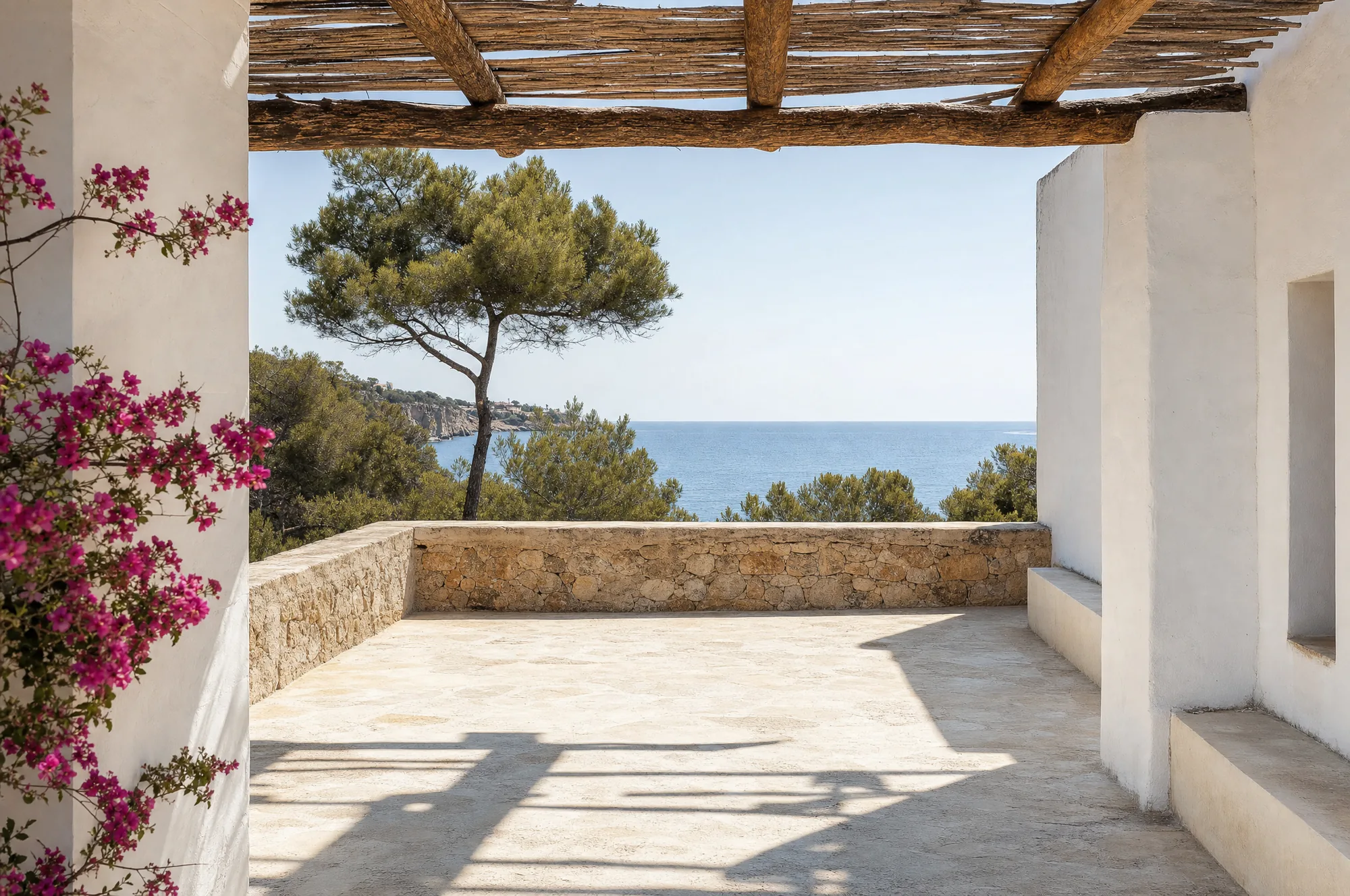
Light. Island light on Mallorca and Ibiza is the clearest of the three, with less humidity and more reflected brightness off pale limestone and the sea. It is unforgiving of poor material choices and rewards restraint.
Terrain. Much of the most desirable land is classified as rural, not urban, which restricts what can be built and where. Traditional Mallorcan fincas sit on stone-walled agricultural land that predates any zoning system.
Local construction style. Marès limestone, quarried locally on Mallorca, thick load-bearing walls, small deep-set windows, and exposed sabina wood ceiling structures define the vernacular. Contemporary architecture on the islands increasingly restores and extends these structures rather than replacing them.
Urbanism in one line. Building outside established urban boundaries is tightly restricted by island planning authorities, and any project on rural land requires specialized due diligence before a design is even started.
Seasonality. Tourism demand is intensely seasonal: summer is dense, winter is quiet, which affects contractor availability and, on Ibiza in particular, ferry-dependent material deliveries.
Getting there from the US. There are no direct flights from the US to Mallorca or Ibiza; the standard route connects through Madrid, Barcelona, or another major European hub before a short final flight.
Side by side
| Côte d'Azur | Marbella / Costa del Sol | Balearic Islands | |
|---|---|---|---|
| Light | Soft, diffuse | Intense, direct | Clear, reflective |
| Terrain | Steep, scarce | Gentler slopes, more available | Rural-protected, stone-walled |
| Local style | Belle Époque and Provençal mas | Andalusian and Ibiza-Marbella hybrid | Marès stone finca |
| Urbanism in one line | ABF heritage review near classified sites | Municipal plan varies by town hall | Rural land tightly restricted |
| Peak season | July–August | Mild year-round, busiest socially in July–August | Summer dense, winter quiet |
| From the US | Direct or near-direct via Nice | One connection via Madrid or London | One connection via Madrid or Barcelona |
What the three regimes actually ask of you
The difference between these markets is administrative before it is architectural.
On the Côte d'Azur, the statutory instruction periods are set by the French planning code, two months for a single house and three otherwise, with an extra month near a listed monument; and above 150 m² of floor area the permit must be signed by an architect registered with the Ordre (article 4 of the 1977 French architecture act, ceiling in a 2016 decree). Lighter works may need only a déclaration préalable.
In Marbella and Andalucía, the ground is the municipal building licence; the procedure is described in the the Junta de Andalucía guide to building licences, and the regional framework has just been reworked by Ley 5/2025 de Vivienda de Andalucía.
In the Balearics, urban planning is governed by the 2017 regional planning act, and works that create neither new build nor extension can in some cases proceed under a declaración responsable, with a first-occupation licence still required at completion. We have not verified a stable official link for that text, so treat this paragraph as a pointer and check the current municipal rules before you make an offer.
How to actually decide
If your priority is minimizing flight time and maximizing the chance of year-round personal use, the Côte d'Azur has the edge on access. If your priority is buildable land at a range of budgets and a more predictable planning culture, the Costa del Sol tends to move more smoothly. If your priority is architectural authenticity and you are willing to work within tighter land-use rules, often restoring rather than building new, the Balearics reward that patience with a result nothing else in the Mediterranean quite matches.
None of these factors should be decided from a listing photo. They are best tested on the ground, ideally walking a shortlist of sites with the architect who will eventually be responsible for what gets built on them, which is a different conversation than the one you have with a real estate agent. For a closer look at what a project actually looks like once you own the land, see the elements of contemporary Mediterranean villa design and how building a custom villa in the South of France actually works for American buyers. For the material palette that ties all three regions together, stone, lime and light covers the underlying logic in depth.
Send us the listing before you make an offer, not after. The one thing that cannot be undone is buying a plot that will never allow the house you have in mind. We will tell you honestly what it permits, including when the answer is that you should walk away.
Frequently asked questions
Which Mediterranean destination is easiest for an American buyer to build in? The Costa del Sol around Marbella generally offers the most straightforward combination of available land and an established international buyer market, though planning timelines still vary by municipality. The Côte d'Azur offers the easiest flight access from the US but the most restrictive heritage oversight near the coast. The Balearics offer the most distinctive architectural result but the tightest land-use rules.
Is it better to buy an existing villa or buildable land? It depends on the destination. On the Riviera and in the Balearics, buildable coastal land is scarce, so renovating an existing structure is often more realistic than new construction. Around Marbella, more genuinely buildable plots exist, making ground-up villas more common.
Do planning rules differ between France and Spain? Significantly. France applies national building codes with departmental and heritage-authority review layered on top, notably the ABF near classified sites. Spain delegates most planning authority to the municipality, so rules and timelines can differ from one town to the next along the same coastline.
Should I involve an architect before I make an offer on land or a property? Yes, whenever the plan involves any renovation or new construction. An architect can flag site constraints such as slope, protected status, heritage review, and access that are invisible in a listing but that determine what you can actually build. This is a short conversation that can save months of surprises later. Get in touch before you sign anything, and we will tell you honestly what a site allows.
Sources checked on 1 September 2026: the French planning code, Légifrance, Junta de Andalucía, BOE.
Studio note. write to us.

Turnkey villa renovation: French Riviera and Costa del Sol
How a turnkey renovation is run from abroad: decision gates, site reports, local trades and the calendar of a Mediterranean villa project, season by season.

Stone, lime and light: Mediterranean architecture materials
The materials that make a Mediterranean villa work: local stone, lime render, terracotta and shade. How each behaves in summer heat, and what each costs to keep.